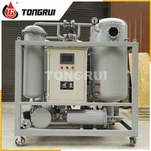
The coalescence separation oil filter has three functions:
1: Filtration and dehydration function to remove emulsified water, free water and impurities in the corresponding oil;
2: Filter the oil separately and use it as a fuel dispenser;
3: Internal circulation is set to facilitate the replacement of coalescing separation filter elements.
The working principle of coalescence separation oil filter machine:
The oil first passes through the fine filter in the system to protect the oil pump from being damaged by large particles of dirt, and then the oil is pumped into the semi-fine filter and then enters the coalescing filter element in the coalescing tank. The free water and emulsified water in the oil coalesce into larger water droplets after passing through the filter element, and sink into the water storage tank under the action of gravity. Smaller water droplets move upwards with the oil to the separation filter element under the action of inertia. The separation filter element is made of a special hydrophobic material. When the oil passes through, the water droplets are blocked from the outside of the filter element. After gathering with each other, the size gradually increases, and finally settles into the water storage tank at the lower part of the coalescing tank due to gravity. . After the oil is dehydrated, it enters the fine filter to ensure that the cleanliness of the oil entering the user's tank meets the design standard. The oil flows through the special filter element, and passes through the gradually narrowed pore structure of the filter element from the surface to the inside, along the flow direction, to intercept the pollution particles of different sizes in layers, which maximizes the service life of the filter element and the filtration efficiency.
What are the differences between coalescing separation and aggregation vacuum dewatering oil purifiers?
The filtration process of coalescing separation dewatering oil filter is as follows: first, the oil enters the primary filtration, the large particles of impurities are retained, and the oil after removing the large particles of impurities is transported to the fine filter by the oil pump, and the smaller impurities are removed in the fine filter. , Continue to enter the coalescing separator, which uses the principle of molecular separation technology to analyze the oil under pressure and eliminate the intermolecular binding force, so that the dissolved water and free water in the oil can quickly break the oil film to separate from the oil molecules and separate out. So far, the dehydration and removal of impurities are completed.
Note: This type of coalescing and separating oil filter mainly relies on the stainless steel mesh filter to intercept impurities, and the impurity interception belongs to precision filtration; while the "dehydration treatment" relies on the coalescing filter and the separation filter to filter dissolved water and free water. Emulsion breaking and water separation treatment, because this type of equipment can be dehydrated and filtered without any heating device, so it is mainly aimed at light oil products (such as kerosene, gasoline, diesel or other low-viscosity lubricating hydraulic oil).
Coalescing vacuum dewatering oil filter purification process: the oil passes through a stainless steel filter with a large amount of dirt to remove impurities, using a special water separator and a personalized vacuum separator, which uses lipophilic and hydrophobic technology and "cavitation". "Principle, the contact area of the oil in the vacuum separator is expanded hundreds of times of the original, and the "cavitation" system continuously increases the oil evaporation surface area, and the evaporation interface is constantly updated, maximizing the increase in oil The stroke and static water volatilization area in the vacuum system make the water in the oil vaporize and evaporate quickly under the conditions of low heat, high vacuum, large surface and high pumping speed, and then be discharged by the vacuum system.
The water and gas discharged from the upper part of the vacuum separator are cooled and dehumidified step by step through the cooling system, and finally discharged into the air by the vacuum pump.
The dry oil in the vacuum separator after vacuum vaporization and dehydration is raised from negative pressure to positive pressure by the oil transfer pump. After fine filtration, the clean oil is discharged from the oil outlet to complete the entire oil purification process.
Note: The coalescing vacuum dewatering oil filter adopts the world's "cavitation" principle and coalescing separation technology, and cooperates with a special polymer material demulsification device, which can quickly and easily separate the liquid water and free water in the oil, and can also Removes dissolved water from oil. It can make the heavily emulsified lubricating oil clear and transparent, and meet the requirements of hydraulic lubricating equipment.
This type of equipment has an electric heating device, which is wider than the coalescence separation dehydration oil filter. It is used in hydraulic oil, medium and low viscosity lubricating oil, hydraulic transmission shaft, gear oil, gasoline oil, diesel oil, compressor Purification of oil, refrigeration oil, anti-wear oil, etc. Because this type of equipment also has the effect of vacuum degassing, it is not suitable for filtering volatile oils, such as gasoline and kerosene.